Showing posts with label Aliya. Show all posts

Tuesday, February 4, 2014

Anglo-list: Suzanne Suckerman

I made Aliyah (immigration) to Haifa, Israel seven years ago at the tender age of fifty nine. The challenges of learning a new language, adjusting to a new culture, and making friends has been frustrating and at times overwhelming. Many resources are available to newcomers to Israel to help succeed in their new home. The Anglo-list website is one of them. My friend Suzanne Suckerman is the owner and developer of Anglo-list.

The site is all about bridging the social and cultural gap; what to do, how to do it and where to do it. Practical information from locals and experienced olim, is key to a successful integration and absorption. In this site you'll find information on Aliyah; learning Hebrew, employment, finances, health-care, general services, communities, Hebrew English translations and resources of all kinds.

In the Anglo-list they truly understand the challenges and frustrations of Aliyah and relocation. They understand what it is like to find your way around a new city, making friends, learning Hebrew and finding a suitable job. They even understand the challenges of dealing with the bureaucracy at the government offices. Suzanne herself is an immigrant, who immigrated to Israel with  her family from South Africa.

Hundreds of Aliyah and relocation tips make this site unique; the Israel education system, local transport options, the housing market, and shopping and consumer issues in Israel. They offer aid to help you learn Hebrew; a phonetic dictionary of common Hebrew words and phrases will get you communicating from day one, and so will the list of Israeli and Hebrew slang words and expressions. Translations of all kinds; your payslip, household bills, and Israeli bank documents, have been included. They address your finances, your Aliyah budget and will even teach you to save and stretch your Israeli shekel.

Resources and contact information for the various government offices, emergency services, Jewish Federations, embassies, consulates and volunteer organizations are included.

You can take an active part in the site; comment on articles and share your Aliyah or a relocation story. Network socially and professionally, exchange advice and information when you join their huge on-line community on Facebook, Twitter, and Linkdin. My friends from the Haifa Writer's group posted some of my stories throughout the years and Jona's great tale about marriage in Eretz Israel has been published there as well.

There is a Business Directory which connects you with English speaking, oleh friendly, professionals in your area. The Classified Directory is the place to post your 2nd-hand items, swaps and give-aways, rentals, JOBOPPS and JOBSEEKS.

Advertisers are connected to an English speaking clientele, get extra traffic to their websites and benefit form an enhanced on-line exposure. We have promoted our writers' group with success through Anglo-list.

The site offers wonderful support to newcomers to Israel, and can be a great resource of information for those simply interested in learning about Eretz Israel. Anglo-list helped me find a great attorney, make some friends, locate social events, and learn a lot about my new home.

Suzanne Suckerman


Monday, June 3, 2013

Scenes from a Haifa Mall


The Panorama Towers viewed from Hadar
The Ego Food and Coffee in the world famous Dan Panorama Hotel Mall is my favorite place in Haifa to eat Cinnamon rolls and sip an occasional vodka and diet coke. The cafe is located in the center of an upscale shopping mall within the hotel facility. There are two levels of jewelry shops, restaurants, clothing stores, and my spiritual home - the local Habad gift shop and study center. The building is modern and well lighted, unfortunately it seems to always have a musky smell perhaps that of mold in this humid metropolis, and the background music always seems just a bit too loud. The hotel is part of the Dan Hotels Corporation founded by the Federman family in 1947. They own the world famous King David Hotel in Jerusalem and luxury hotels throughout Israel. They operate a school for chefs in Haifa and help cater The Israeli Defense Forces. I am planning to study sugar sculpturing 101 at the vaunted institution of higher learning.

The Ego is owned by Serge and Hannah. They are vatikkim (or old timers) in Israel. Serge is a French oleh or immigrant who came to Israel in 1948. Hannah and family came during the same period from Chelm Poland, yes the famous home of Polish humor. Both of them were fortunate to come from families that managed to escape the horrors of the holocaust. They have two sons in their twenties and five grandchildren.


Sitting at the Ego cafe
The cafe serves family style meals in respects similar to a mid-priced cafe in the states. Patrons and employees come from every nation and background on earth. The world famous Bahai Gardens is a few hundred yards behind the hotel, which means that we hear several languages spoken every time we enjoy the culinary delights of The Ego. Baha'i visitors come from all over the world. The languages of Israel, Hebrew, Arabic, and English are dominant but Spanish and Russian are widely spoken as well. My favorite servers Samantha and Eileen are from Argentina and converse in Spanish at home and work. My American style Espanol is a great source of joy to them due to my accent plus hesitancy in pronouncing the words. We just laugh and enjoy the sense of camaraderie. Samantha is about twenty five and studying graphic arts. Eileen is just twenty and recently completed two years of national service in place of the required military service for women in Israel. Her family is Haredi or Orthodox and she chose to do volunteer service for our country. She had the option as a religious Jew to avoid any commitments. Eileen, like many Israelis never forgets the lesson of Nazi tyranny and found a way to serve her country. We have no other choice. Many of our enemies still vow our destruction.


Katia is another one of my favorite servers. She is razor thin, aged twenty, and a former citizen of Russia. She informed us yesterday with great joy that she just got married. We inquired about the details. All of us were taken by surprise. She responded by telling us that they eloped to Cyprus. It was not done simply for romantic purposes. She and her spouse are not from religious backgrounds and never received formal Jewish studies. The laws relating to marriage in Israel are strictly Halacha based. As a result, non-traditional Jewish couples are forced to submit to an Orthodox marriage ceremony with an Orthodox rabbi and are compelled to classes on family purity. No Israeli may marry outside his faith community. Hundreds of thousands of Israeli citizens from the former Soviet Union who are not Jewish or whose Jewish ancestry is in doubt are unable to marry at all inside Israel.


Britt, Katia, and Danit


Mati is another of the employees of The Ego. She is twenty and from Jerusalem. Her family is very Haradi or Orthodox Jewish. They immigrated from Morocco in 1952 along with tens of thousands of Olim from Arabic countries. Many of the citizens of Israel come from similar backgrounds. She has jet black hair and is a student of architecture at The University of Haifa. Sadly, my friend is now living in Haifa because she fled her Orthodox home to study and learn about the world outside of traditional Judaism. Her family in many ways has rejected Mati. "I wanted to learn to be an architect she moaned". Woman should have the right to learn, study, and travel. Her story is not unusual in this complicated nation. She is leaving next month to work in Canada for a year. She wants to earn money of course, but fine tuning her English skills is her main goal. This is very common among young Israelis.


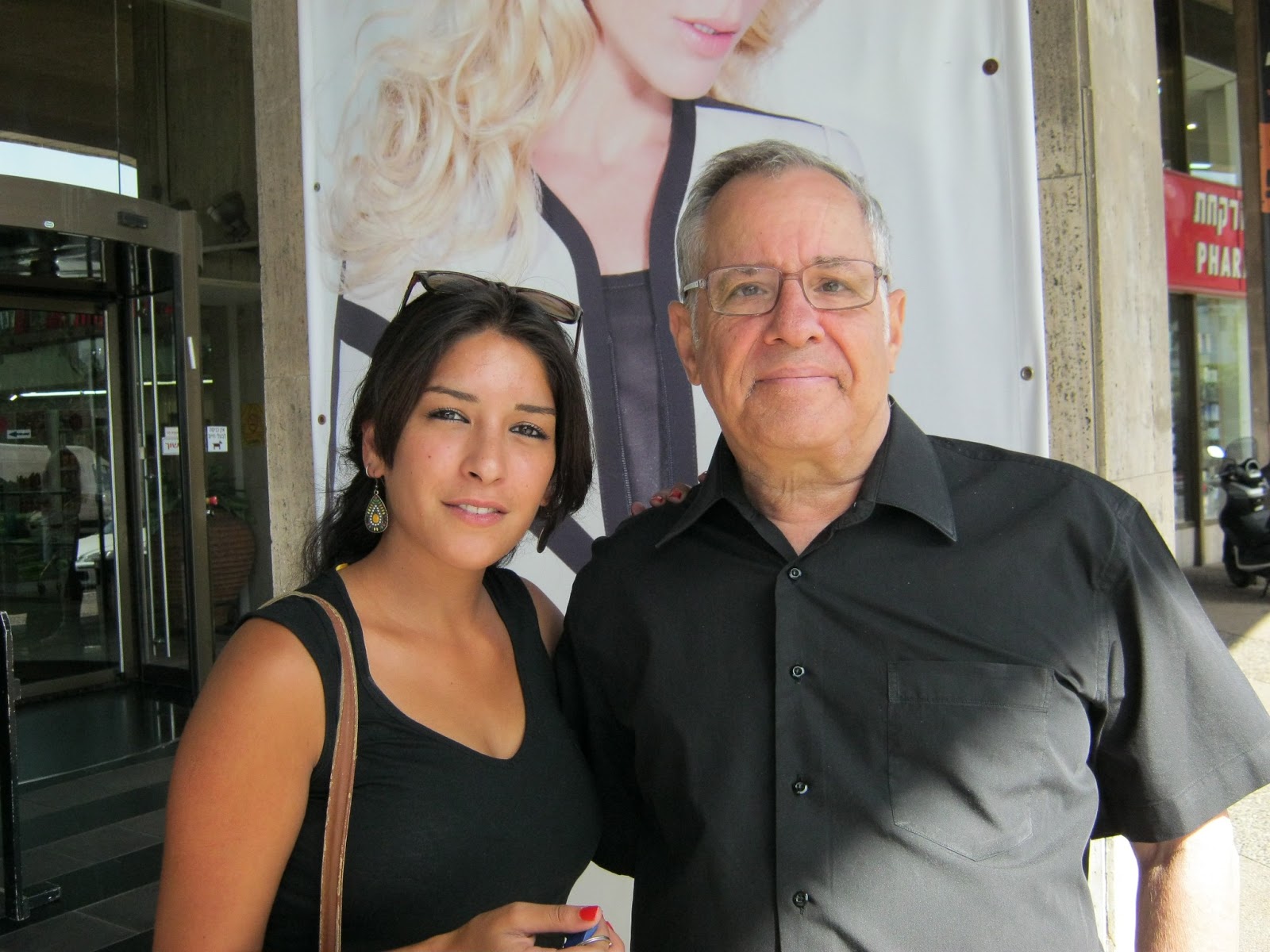
Earl and Mati
Serge is a hair stylist. He and his wife also own the upscale beauty salon in the mall. The services include pedicures, manicures, and facials. Liah who performs these wonderful services is in her late 30s, married, and the mother of two teen aged sons. 
She was born and raised in a Kibbutz or collective settlement in northern Israel. Her family moved to Haifa five years ago to enjoy the benefits of city life. "We were just plain bored and grew tired of agricultural life" explained Liah. The trend from rural to urban life in Israel is fairly widespread as it is in much of the world.


Today is Monday and, as usually is the case, the mall is filled with shoppers, employees, and hotel guests from virtually every background and nation on earth. I am writing this post while listening to numerous languages spoken simultaneously around me. Jews, Christians, Druze, Muslims and of course Baha'i work together, shop together, and of course enjoy the food at the wonderful cafes. The is a reflection of life in this wonderful city. The manager of the elegant Dan Panorama dining room is a Christian with Italian roots. His family came here long before 1948.
Another of the cafe managers, Muad is a follower of the Ahmadiyya stream of Islam. There are about one hundred million Ahmadis in the world. They rarely get much attention due to the fact that are universally peaceful. 


Ego Cafe (All rights reserved to www.haifacity.com site)

Haifa indeed earns its reputation as The City of Peaceful Coexistence. Jews, Christians, Muslims, Druze, and others live together with a fair degree of respect and freedom. The mall is a panorama of life in our beloved city. People often ask me why life in Israel and the rest of the region is not similar to the one that we share. The answer is that this is a unique and separate urban entity. The conditions that exist in Haifa differ from those in other communities in our region. Is life in Detroit the same as San Francisco? Hebron and Ramallah are also different places. Israel has a wide variety of political parties, social views, family backgrounds, and ethnic origins. The same is true of our Palestinian neighbors. Life here does offer hope that people can live together in harmony in this troubled region. Will it happen? Haifa is an example of one community in this region where it has been done. Hopefully, others will do the same.


Monday, July 30, 2012

Israel's Clandestine Army


I immigrated to Haifa, Israel five years ago from Colorado in the USA. My permanent move came at the age of fifty eight. This morning I went to visit the Clandestine Immigration and Naval Museum located in Haifa.. The museum faces the Mediterranean Sea close to the Shrine of Elijah The Prophet. The museum features the story of the hardships of fighting for the right to live in our homeland and the history of the Israeli Navy. The immigration story is told by documents, articles of the time, models, photos, sound shows and diagrams. The ship "Af-Al-Pi-Chen", which ran the British blockade during the mandatory period, brought 434 immigrants to the country, houses most of the museum devoted to the clandestine immigration and to the history of Israel’s Navy up to the Yom Kippur War. The most famous clandestine immigration ship was the Exodus which docked here in Haifa.

From the end of World War II until the establishment of Israel (1945-1948), illegal immigration was the major method of immigration, because the British, by setting the quota at a mere 18,000 per year, virtually terminated the option of legal immigration. Sixty­ six illegal immigration sailings were organized during these years, but only a few managed to penetrate the British blockade and bring their passengers ashore. In 1947, 4500 immigrants on the Exodus were sent back to Europe by the Mandatory government. The British stopped the vessels carrying immigrants at sea, and interned the captured immigrants in camps in Cyprus; most of these persons only arrived in Israel after the establishment of the state. Approximately 80,000 illegal immigrants reached Palestine during 1945-48.


Forty four years ago, I was a communications student at the University of New Mexico. The year was 1968 and like many youth of my era, I sought something rewarding and exciting to do with my life. I still had two years of studies to finish, but was unsure of my goals for the future. I volunteered to do a six month work/study program at a kibbutz (collective settlement) in southern Israel, named Hatzor. The primary purposes of such programs was to promote Aliyah or immigration to Israel. Participants split the day evenly between work at the Kibbutz and Hebrew study in an Ulpan. 

Kibbutz Hatzor (taken from the blog Tiyul Bair - a tour of the city)

I soon discovered that sitting in a classroom was unsuitable for me. Conversely, my job as assistant Kibbutz caretaker was a perfect match. I delivered supplies throughout the settlement, did the gardening, collected the garbage, and did general maintenance. My supervisor, Shmuel, was a forty+ American born Kibbutznik. Shmuel was a short thin fellow with a moustache, slight limp, and ever-cheerful smile. He was very friendly, but said little about himself. He mentioned that he had come to Israel in 1948 from New York as a volunteer, was married, and had a teenage son. He had studied journalism in New York and limped as the result as a car accident in “The Big Apple”.

My six months at the Kibbutz went quickly. I did not acquire a lot of Hebrew; nonetheless, I made many wonderful friends and learned to be a pretty fair maintenance man. The Kibbutz members were the most wonderful people. Many were survivors of the Holocaust. A number came to Israel as volunteers in 1948, primarily from The United States. They came to protect and build a new nation. At my “Going Away” party, I was stunned to learn that Shmuel and several of the other Kibbutz members were crew and passengers on the famous immigrant ship “The Exodus”. They had braved the British embargo to bring illegal immigrants into "Palestine." Some were interred in British prisons. For their first decade in Israel, they often lived in treehouses and tents. The situation was further compounded by conflict with the Arab legions during the struggle for a safe Jewish homeland. Some of their comrades died, or suffered serious wounds during their fight for freedom. Yet, they were warm, humble, and generous souls. Many of the volunteers had been members of Mahal.

The Mahalniks were mostly World War II veterans from American and British armed forces. Allied armies were reduced considerably after the end of the war and many soldiers were demobilised; moreover, the service experience became mundane and did not resonate with some servicemen, particularly pilots. In various circumstances they were invited, or heard of the Jewish state’s struggle for independence and enlisted. There were Jews and Christians, both ideological supporters of Zionism and just plain idealists. 


The Ha’apala movement, also called “Aliyah Bet”, which attempted to evade the 1939 and 1948 British Naval blockade restricting Jewish immigration to Palestine, was assisted by 236 Mahal former servicemen of the Allied Navies as crews of ten clandestine Jewish refugee ships, out of sixty-six participating vessels.The Exodus was the most famous of the clandestine fleet.The story was told in both print and in film. No one can accuse history of not having a sense of irony. Sixty-six years ago, in July 1947, a passenger ship destined for Palestine and named the Exodus was stopped and boarded by the British navy. 
Clandestine Immigration and Naval Museum in Haifa

The ship was crowded with Holocaust survivors determined to make a new life for themselves in British-controlled Palestine. The British, facing Zionist terrorism and trying to keep promises made to the Palestinian Arabs to limit Jewish immigration, were determined to stop it. Accordingly, when the Royal Navy boarded the ship twenty miles out from Haifa, a full-scale battle ensued. Three immigrants were killed and dozens injured as British troops beat the passengers on to three separate prison ships. From there these Holocaust survivors were transported back to Germany and were once again placed in camps. The world was horrified. Since then, the fate of the Exodus has achieved legendary status: Leon Uris used it as the basis of his 1958 bestseller of the same name; an award-winning film. It was "The Ship That Launched A Nation".

The 1948 Arab-Israeli War saw approximately 3,500 foreign volunteers from forty-three countries among the Jewish forces, out of an estimated 29,677–108,300 total (its size grew considerably in later stages of the war owing to immigration into Palestine). A total of 119 Mahalniks were killed in battle.

One of the most senior Mahal personnel was Mickey Marcus, a Jewish United States Army colonel who assisted Israeli forces during the war and became Israel’s first Brigadier General. Marcus’s wartime experience was vital in breaking the 1948 Siege of Jerusalem. He was killed during the war. 


" The Machal forces were the Diaspora's most important contribution to the survival of the State of Israel " "David Ben-Gurion, Founding Father and first Prime Minister of Israel"

.