Monday, April 8, 2013

The Muslim Ahmadiyya in Haifa Israel


Many people outside Israel are not aware of the fact that 20% of Israel’s population are not from a Jewish background, and that among them are Christians, Muslims, and Druze. The majority of people outside of this area are unaware of the diversity of streams within these faiths. One of the most interesting aspects of life in Israel to me is that each of the major religions is represented by a myriad of these religious allegiances. The differences aren't just theological, but are also social, political, financial, and educational. For example, there are several Arab political parties in the governing body of Israel – The Knesset. There are numerous Jewish political parties with a wide divergence of philosophy and goals. The diversity in social, cultural, religious, and other ideology has been a great shock to me as a new immigrant to Israel. This is also my greatest challenge in my new life in Haifa: to understand and appreciate the complexity of my new society.

Haifa is the spiritual center of the Ahmadiyya in Israel. This is a Muslim religious movement numbering in the millions worldwide. The majority of the movements’ members live in Pakistan and India, but they have a significant population in over 195 countries in the world. In Israel their numbers are small, and they are primarily reside in the Cabbabir neighborhood. This is a village within Haifa, which is the third largest city in Israel. I live next to this pleasant community of mid-priced homes, tree lined streets, parks, and small cafes. The lower part of the community has a wonderful view of the sea. I love to wander around the area and mingle with the local residents. Arabic and Hebrew are widely spoken there as in much of Israel.


The Ahmadiyya is an Islamic religious movement which was founded in India near the end of the 19th century, originating with the life and teachings of Mirza Ghulam Ahmad (1835–1908). Mirza Ghulam Ahmad stated that he had been bestowed the attributes of all Biblical and non-Biblical Prophets, in accordance with a verse of the Qur’an which states that all prophets will converge into one person in the future. Mirza Ghulam Ahmad stated that this was due to his receiving revelation from G-d in which G-d called him: 
The Champion of Allah in the mantle of Prophets.


He claimed that he was the Mujaddid (divine reformer) of the 14th Islamic century, the promised Messiah and Mahdi awaited by Muslims. The adherents of the Ahmadiyya sect are referred to as Ahmadis or Ahmadi Muslims. Ahmadi emphasis lay in the belief that Islam is the final law for humanity as revealed to Muhammad and the necessity of restoring its true essence and pristine form, which had been lost through the centuries. Thus, Ahmadis view themselves as leading the revival and peaceful propagation of Islam. The Ahmadis were among the earliest Muslim communities to arrive in Britain and other Western countries.


Orthodox Muslims consider the Ahmadi movement to be heretical and non-Muslim for a number of reasons. The primary reason is the question of the finality of prophethood, since they believe members of the Ahmadiyya Muslim Community do not regard the Islamic prophet Muhammad as the last prophet. Mainstream Muslims do not accept Ghulam Ahmad to have fulfilled the prophecies about the Promised Messiah and Mahdi. According to mainstream Muslims, Ghulam Ahmad’s failure to establish a perfect worldwide Muslim government invalidates his claim to be the promised Mahdi and Messiah and hence he is seen as a false prophet. The Ahmadis suffer discrimination in many Muslim nations due to their interpretation of Islam and in other nations where people perceived all Muslims as violent or as cultural threats.

Ahmadis also hold that the Muslims have erred with regard to the rights of creation for they, unjustly raising the sword and calling it Jihad, have misunderstood the concept and purpose of jihad in Islam. The motto of the Ahmadiyya Muslim Community is “Love for All, Hatred for None.”
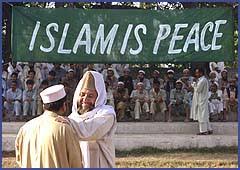


Islam, a name given by Allah to this religion (Quran 5:4), is an Arabic word which literally means obedience and peace. ISLAM is derived from the Arabic root “SALEMA”: peace, purity, submission and obedience. So Islam would mean the path of those who are obedient to Allah and who establish peace with Him and His creatures. Its followers are called Muslims.

The Ahmadiyya live as peaceful and responsible citizens of Israel, as they do in all countries in which they inhabit. I have been blessed to participate in many interfaith activities during my five years in Haifa. Several of these activities have been with my Ahmadi friends and neighbors. My favorite was a youth soccer tournament held at their local school in Haifa in the fall of 2009. In this event, Jewish and Muslim youth enjoyed a beautiful fall day of sports, pizza, and fellowship! Rabbi Edgar Nof brought a group of Jewish sports warriors. They were age eight and nine, both male and female. His team was coached by Timothy Crowe, a visiting Southern Baptist from Dallas Texas. We all had great fun and built friendships that we still enjoy today.


I would like to offer my most sincere thanks to my friends in the Ahmadiyya community for helping me to adjust to my new and exciting life in Haifa Israel.


.

Thursday, January 17, 2013

A guest post - introducing my colleague writer David Prosser


I would like to introduce my colleague writer David Prosser, who has kindly received my invitation to share a post in the blog:
Born in 1951 David Prosser led a perfectly normal life until inheriting a manorial title aged 40. Though he didn't become independently wealthy overnight as he'd hoped, he did find his responsibilities changed and his outlook had to broaden exponentially.
Image
 :David writes
 I worked in Local Government for most of my working life but was forced to retire when ill health took its toll. Now having to spend much of my life indoors and unable to communicate easily with people face to  face, I was able to establish good contacts over the Internet and devoted myself, amongst my other fundraising activities, to raising enough money to build a school on Uganda for the street children. Those orphaned and left with no-one to care for them. (Baron) Cornelius von Berenberg Gossler has given up his life of privilege in Germany to devote to these children with his beautiful Ugandan wife Loy. I was fortunate to be able to bring in enough promises to build the school, dormitories and a clinic outside the village of Loy's tribe.
Other projects took my time also. Not least a friendship site (The Buthidars) to cover the world which would allow friendship to flourish despite differences between people by ignoring the religion that would generally keep them apart. We also had on hand voluntary advisers for people with problems like arranged marriages. Peace in the world is a possibility if there are enough examples shining out, and for the sake of our children we need this.
One day a friend on the net asked me 'how my day had been' and I responded in the form of a diary entry. She liked it and asked for more which I did for about a week. Then she suggested it would make a good book. I was very dubious about that but decided to give it a go by doing a chapter a day as though completing a diary and asking my wife to read them overnight. If I heard laughter coming from her room I knew I was OK. Eventually my first book was born called 'My Barsetshire Diary'. At 60 I was an author!
Two more books have followed since then, one a self indulgent bit of fun in the form of a prequel which has me as a poor man's James Bond.  Such fun to write and it got me some lovely reviews.
More recently I joined Gather.com as an alternative social network to Facebook. I was lucky enough to meet Earl Shugerman who told us all about his move to Israel and offered flying tours around the place with his splendid writing. One thing that especially caught my eye was the story of a town where, though the rest of us see as the warring factions, people actually live together at peace. Haifa is the city of peaceful coexistence. It's heartwarming and leaves me full of hope. Earl has a part to play in all this by letting us know how it will be shared. I hope you enjoy his story as much as I have and will share his new site.


Tuesday, January 15, 2013

Caesarea Israel from Roman Gladiators to Peace?

Caesarea is a small, very well-to-do town and extensive archaeological site on the Mediterranean coast of Israel, located some 50 km north of Tel Aviv and several km north of Hadera. The current population is 4,200. Beyond the ancient remains, Caesarea is a town devoted to tourists and to luxurious living. Some of Israels’ finest homes are located here and it is also home of Israel’s only 18-hole golf course, a luxury hotel, a vacation village, miles of sandy beaches, and a series of attractive restaurants, galleries and boutiques.  And, of course, visitors marvel at its extraordinary archaeological attractions, not least of which is the Roman theatre, where concerts, entertainment extravaganzas and the annual International Opera Festival are held.  I love to visit the city which offers ancient Roman ruins and Israel's only golf course. Golf and jazz are my two favorite hobbies. 

Thumbnail


In the late nineteenth century and early twentieth century Baron Edmond James de Rothschild purchased much of the land around Caesarea - with the establishment of the State of Israel in 1948, the Rothschild family gifted these holdings to the Caesarea Foundation. The Caesarea Edmond Benjamin de Rothschild Development Corporation remains the operational arm of the Rothschild Foundation.

Are you a fan of Roman history? Yes, Caesarea is city that Herod the Great dedicated to Caesar the great two thousand years ago.


Settlement at what became Caesarea, on Israel’s central Mediterranean coast began in the third century BCE by the early Greeks. The population of "Straton’s Tower" remained Jewish until the Romans conquest in 63 BCE, when they granted the city its freedom. King Herod the Great transformed the city beginning in 22 BCE with the construction of its sophisticated port, warehouses, markets, great streets, bathhouses, temples and magnificent public buildings, naming it Caesarea. Every five years the city hosted gladiatorial games, sports competitions and performances.

Thumbnail


Caesarea is an important site in Christian history. It was the place where Pontius Pilate governed during the time of Jesus. This was where Simon Peter converted the Roman, Cornelius, the first non-Jew to believe in Jesus.  During the 3rd century, Caesarea was a center of Christian learning. In the 4th century, the site converted to Christianity and became a major center of the Christian Roman Empire.

In 640 CE, Caesarea was the last Palestinian city to fall to the Muslim invaders. After the Muslims swept out of Arabia and across the Middle East, driving out the Romans, Palestine was largely neglected. In 1101, the Crusaders captured the city under the leadership of Baldwin I, only to lose it in 1187 to Saladin. Under the Crusader rule, the Jewish community of Caesaria dwindled until in 1170 only 20 Jews remained. From 1251-1252, the city was entirely reconstructed by Louis IX.

In 1265, Caesarea fell to Baybars, the Mamluk sultan of Egypt, who destroyed the city, which remained in ruins until 1884.  In 1884, a small fishing village was established on the remains at Caesarea by Muslim refugees from Bosnia. The city was abandoned by its inhabitants during the War of Independence (1948).

The city that sadly has such a history of suffering and violence is now one of peace and tranquility.

I have been blessed to participate in interfaith activities in Israel by the Catholic Focolare. The Focolare Movement is an international organization that promotes the ideals of unity and universal brotherhood. The Focolare Movement operates in 182 nations and has five million members. It is the largest Catholic outreach movement in the world. Here in the Holy Land, Run4Unity was held May 13 in the natural landscape and archeology of Caesarea Maritima, with more than 400 boys and girls between 12 to 17 years old, from the Palestinian territories and cities of Israel participating in games to promote peace. Christians, Muslims and Jews enjoyed the 
glorious scenery and spirit of brotherhood participating in a variety of games. 

www.run4unity.net is a great site to learn more.


Children of different races, cultures and religions ran together, through significant places on the planet, to show their commitment to peace and solidarity. 

I was one of the "security guards". My primary duty was to urge both the kids and their families not to wade into the calm and beautiful Mediterranean waters. I volunteered to be one of the security guards during the period of time prior to the beginning of the organized events. I happened to hear three of the young people communicating with each other in perfect English. They were dressed in the uniforms of the activity. Participation from English speaking countries is rare in this region. I asked them where they were from and they answered in unison and with great pride that "We are Palestinians from Ramallah." Then they proceeded to tell me that they had lived in Indiana for many years, which explained their wonderful grasp of English. We discussed in length my favorite topic, which of course is food. We all reminisced about Mexican Food, Wendy's, barbecue spare ribs, and of course McDonald's burgers. 

They proceeded to add this statement; "We have visited Haifa which is a primitive place". I hesitated and thought it best not to respond. The rules of these activities strongly admonish political discussions. They quickly added to my relief that "You do not have KFC in Haifa", with great glee. KFC opened a branch in Ramallah in February becoming the first American fast food chain to directly open a location in the Palestinian territories. We proceeded to eat Pizza, drink Coca Cola, and enjoy the wonderful event. Food is indeed the universal language. The youth enjoyed a series of beachfront sports activities, drank Pepsi, ate pizza and most importantly enjoyed the sense of brotherhood. Sadly, since the activity took place fighting once again erupted between Israel and the Palestinians in Gaza. Fortunately Ramallah was not involved in the battles, but I now have friends in Gaza as well. I also know many Israeli kids who served during the warfare. How far have we come from the days of the Romans and the gladiators? I feel reassured to know that people from both sides of the border are seeking ways to live in peace through dialogue. Let us hope that they succeed.

Saturday, January 12, 2013

Hadar (Splendor) in Haifa Israel

I am sitting at my favorite cafe in Haifa, the Kapiot drinking Cafe, and am blessed to have met a nice Israeli bachura (young lady) named Tal Or who is an Israeli Hayelet or soldier. She is nineteen and like all Israeli women is expected to serve two years in the Israeli Defense Forces.  She is from Haifa and suggested that I tell the readers about her favorite neighborhood of Haifa. We can see Hadar and the famous Baha'i Gardens from the pub which is located in central Haifa or the "Mercaz".


Hadar, which is located in the downtown part of Haifa, derives its name from Isaiah 35:2. The name Hadar is roughly translates into the word splendor in English. The neighborhood of Hadar Hacarmel was founded before World War I.  By 1944, most of Haifa's 66,000 Jewish residents lived in Hadar Hacarmel. Haifa's city hall, courthouse and government buildings were located in this neighborhood, but relocated to the lower city (Downtown) in the turn of the 21st century.  Israel was then part of the British Mandate of Palestine. Hadar at the time was a bustling booming community that served as a government, commercial, and residential center of Haifa. It indeed deserved the description of glorious.


The Technion which is a public research university in Haifa, Israel, was founded in 1912 and is located in Hadar. The Technion, the oldest university in Israel, was located in Hadar until the new Kiryat Hatechnion (Technion City) campus was inaugurated in Neve Sha'anan in the late 70's. The old historic building, dating from 1912, is now a hands-on science museum - MadaTech - the Israel National Museum of Science, Technology, and Space. One of the Technion founders was scientist Albert Einstein. 

The Carmelit, Israel's only subway, runs from the Carmel Center to Paris Square via Hadar Hacarmel, where three of its six stations are located. It is unique in the sense that it is the world's shortest railway. I enjoy a weekly visit to Hadar to drink a cup of coffee on Nordau Street which is the entertainment center of the neighborhood. It is great Keff or fun to travel there on the Carmelit from my home in the Mercaz.  My favorite McDonald's in Haifa is on Hertzel street which is the main shopping thoroughfare in the area. I love to eat an ice cream cone and window shop at the many shops located on Hertzel, which are often family owned. 

Beit HaGefen, an Arab-Jewish cultural center, is located on the seam line of Hadar HaCarmel and Wadi Nisnas. The neighborhood has many Bauhaus Staatliches. Commonly known simply as Bauhaus, the Bauhaus Staatliches was a school in Germany that combined crafts and the fine arts, and was famous for the approach to design that it publicized and taught. It operated from 1919 to 1933. At that time the German term Bauhaus, literally "house of construction" stood for "School of Building" - buildings designed by German-Jewish architects who settled in Palestine after fleeing the Nazis.

Sadly, many of the challenges facing urban areas in most of the world today face Hadar as well. Many of the government agencies have relocated and in addition many Haifa residents are mall shoppers who prefer the Big Malls over the streets of Hadar, and yes Haifa has suburbs. Many of the once splendid homes are now run down and often overcrowded. However, the city is taking steps to renovate the neighborhood. The same challenges and changes facing urban areas in The United States are common in Israel.

Friday, December 28, 2012

Building Bridges for Peace in Haifa, Israel

I immigrated to Israel five years ago from The United States. There is no nation or place anywhere that has more spiritual significance than “The Land of Canaan”. It is the birthplace of the three major faiths: Judaism, Christianity, and Islam. It is the place where King David wrote the 23rd Psalm, where Jesus of Nazareth promoted ideas and values that have changed humanity. In the Quran, the inspired scripture that Muhammad brought to the Arabs, venerates the great prophets of the Judeo-Christian tradition. It speaks of Solomon’s “great place of prayer” in Jerusalem, which the first Muslims called the City of the Temple.

Haifa is the home of the Tomb of Elijah the Prophet, which is considered one of the holiest and most venerated shrines to Jews, Christians, Muslims, and Druze alike.


Haifa is a city dotted with gardens. The most prominent is at the world center of the Baha’i religion, with the tombs of the Bab (Mirza Muhammad Ali) and Abbas Efendi, son and successor of the founder of the abor.faith, Bahá’u’lláh. The presence of the Baha’i, for so long persecuted in various Middle East countries, is evidence of the tolerant social fabric of this city. The greatest challenge facing this small and brave nation is to promote the values of peace in an area filled with strife and hatred. 
“The Golden Rule” is a common link in the three major faiths that can and will draw us together to promote Shalom and Salaam. It is happening in Haifa the city of peaceful coexistence.

I have been blessed to participate in many interfaith efforts in the past five years to promote peace through dialogue in our region. This holiday season I rejoiced to participate in several activities in Haifa to promote harmony. My favorite was an interfaith sports event hosted by the local Muslim Ahmadiyya school in the Kabbabir community in Haifa.


On Wednesday, Dec 19th, 2012, between Hanukkah and Christmas, 50 teens: Israeli Jews and Muslims got together in Games for Peace organized by a new association called GESHARIM LETIKVAH: BRIDGES FOR Hope- HEALING THE WORLD BY BRINGING HEARTS TOGETHER.

The new President of the association, Prof. Jesse Lachter emphasized on what is the motto and core value of this new NGO: ” Love Builds Bridges.”

Reform Movement Rabbi Dr. Edgar Nof started the games by reciting a Prayer for Peace. Then the teen girls played a basketball game for peace, while the teen boys pwer playing soccer. The Jewish children came from the Open School in Haifa with their teacher Ya’ir Shachar. The game referee was Manar, the principal of the Ahmadiyya Muslim School in the Kabbabir neighbor of Haifa. Previous to every game the teens shook hands, and everybody wins by promoting Peace in Israel and by bringing hearts together. Imam Muhammad Sharif declared that their slogan is “Love for all, Hatred for none”. The Ahmadiyya are a world wide movement of more than one hundred million followers dedicated to peace and universal brotherhood. Haifa Mayor Yona Yahav has gone so far as to call them “Reform Arabs.” Most of the two thousand Ahmadis in Israel live in Kabbabir where they are leaders in the business, cultural and most importantly spiritual areas of our community.

“You don’t hear about us because we don’t throw rocks at buses,” stated an Ahmadi leader,“We believe that nothing can be achieved through hatred and hostility.”

All the kids said at the end of the games that it was too short and that they want to meet again. We have planned more activities for the spring. 


Saturday, December 15, 2012

The Importance of Hanukkah .


Hanukkah is one of the most and misunderstood holidays of Judaism. I am looking forward to celebrating the festive occasion with my Chabad friends in my home of Haifa Israel. We have just started Jewish study group for English speakers in our community. This will be our first Hanukkah together in the land where it all started.

The eight-day Jewish celebration known as Hanukkah or Chanukah commemorates the re -dedication during the second century BCE of the Second Temple in Jerusalem, where according to legend Jews had risen up against their Greek-Syrian oppressors in the Maccabees Revolt. Hanukkah, which means "dedication" in Hebrew, begins on the 25th of Kislev on the Hebrew calendar and usually falls in November or December. The timing is based on the ancient lunar calendar. The celebration is based on events that occurred on about the year 200 BCE. However, there are no written records of any holiday observance of Hanukkah until about 500 years later, in the Talmud. Christmas, was not officially celebrated on December 25th until the third century. I have learned from studying both the old and new testament in Haifa that there is no certainty that the date of either is exact. The spiritual significance of the holidays is what is important and should be celebrated and coveted.

The Festival of Lights holiday is celebrated with the lighting of the menorah, traditional foods, games and gifts. Many Jews and non- Jews consider the holiday to have special significance with the return of the Jewish people to the land of our roots. Many of us in Israel and elsewhere consider Israel to be the third "Bayit" (home) or Temple.

According to the Tanakh,
Solomon's Temple was built atop the Temple Mount in the 10th century BCE and destroyed by the Babylonians in 586 BCE. The Second Temple was completed and dedicated in 516 BCE. Two thousand years ago Jews were expected to pray in The Temple. According to classical Jewish belief, the Temple acted as the figurative "footstool" of God's presence and a Third Temple will be built there in the future. Traditionally, Jerusalem has been the focus of longing for Diaspora Jews who were forced from their land and the Temple of their God. Psalm 137 is the well-known lament of the Babylonian Jews who wept "by the rivers of Babylon" and declared, "If I forget you, O Jerusalem, let my right hand wither." 


The History of Hanukkah

The events that inspired the Hanukkah holiday took place during a particularly turbulent phase of Jewish history. Around 200 BCE, Judea region —also known as the Land of Israel—came under the control of Antiochus III, the Seleucid king of Syria, who allowed the Jews who lived there to continue practicing their religion. His son, Antiochus IV Epiphanes, proved less benevolent: Ancient sources recount that he outlawed the Jewish religion and ordered the Jews to worship Greek gods. In 168 BCE, his soldiers descended upon Jerusalem, massacring thousands of people and desecrating the city’s holy Second Temple by erecting an altar to Zeus and sacrificing pigs within its sacred walls.

Led by the Jewish priest Mattathias and his five sons, a large-scale rebellion broke out against Antiochus and the Seleucid monarchy. When Matthathias died in 166 BCE, his son Judah, known as Judah Maccabee (“the Hammer”), took the helm; within two years the Jews had successfully driven the Syrians out of Jerusalem, relying largely on guerrilla warfare tactics.

For an entire generation, the ancient Judeans waged a struggle for freedom, which, in terms of intensity, has almost no parallel in human history. It was among the first recorded wars of liberation and it laid a model for nearly every revolution that followed. With an unbreakable faith and willingness to sacrifice, a handful of valiant Hebrew fighters forged the eternal covenant that resistance to tyranny is the highest and truest service to the universal creator and the highest moral value. Judah called on his followers to cleanse the Second Temple, rebuild its altar and light its menorah—the gold candelabrum of which seven branches represented knowledge and creation and were meant to be kept burning every night.

The Hanukkah "Miracle"

According to the Talmud, one of Judaism’s most central texts, Judah Maccabee and the other Jews who took part in the re-dedication of the Second Temple witnessed what they believed to be a miracle. Even though there was only enough untainted olive oil to keep the menorah’s candles burning for a single day, the flames continued flickering for eight nights, leaving them time to find a fresh supply. This wondrous event inspired the Jewish sages to proclaim a yearly eight-day festival. .

Jewish families across the world just completed celebrated this Inspiring holiday. Jewish children enjoyed spinning dreidels, lighting menorahs and opening presents on the first night of Hanukkah which was celebrated Saturday evening. I enjoyed eating "Sufganiot" or donuts at the Dan Panorama Mall in Haifa. Jewish children sang holiday ballads for mall visitors - many of them visitors from all over the world!

On the first night of Hanukkah, Jewish families began by lighting the menorah, the nine-branched candelabra. Two candles are lit on the first night: the shamash (the helper candle, which is usually the tallest) and one other. On the second night, the shamash and two other candles are lit, on the third, the shamash and three others are lit, etc. This continues for eight nights. To pay homage to the miracle which kept the oil burning, it is typical to eat fried foods such as latkes (potato pancakes) and jelly doughnuts. Children play dreidels (spinning tops), open gifts, eat gelt (chocolate coins) and families say prayers together. It is also customary to increase the amount given to charity during the holiday.

Nearly two thousand years after Judah led his successful revolt, the Jewish people are again free to practice our faith in "The Third Temple". This year marked the sixty fifth of our return to the place where it all started. Hopefully, we will all understand that the greatest message and truest blessing of Hanukkah is that freedom is worth any price that needs to be paid. Next year in Jerusalem is now!

Friday, December 7, 2012

Thoughts About The Kabbalah.

I often have been asked by non-Jews: do Jews believe in heaven and hell? Does Judaism believe in a Messiah, angels or the devil? Do we believe in life after death? What is our perception of G-d and the universe? Judaism allows these cosmological issues to be wide open to personal opinion. Judaism is very much a knowledge- based faith and places far less emphasis on mystical issues than in other religions. The areas of Jewish thought that most extensively discuss these issues, Kabbalah and Jewish mysticism, were traditionally only taught when students had completed their education in Torah and Talmud.

In its narrowest sense, the Torah is the first five books of the Bible. The concept of afterlife is not mentioned in The Torah and does not show up prominently in Judaism until about the third century a.d. This concept showed up in the Talmud very possibly influenced by Christianity and Greek philosophy. The Talmud is the most significant collection of the Jewish oral tradition interpreting the Torah. Gan Eden as an internal reward is linked prominently to the treatment of others by the Talmud and its teachers of that era. Living by "The Golden Rule" was supposed to bring eternal bliss.

The Talmud tells a story of Rabbi Hillel, who lived around the time of Jesus. A pagan came to him saying that he would convert to Judaism if Hillel could teach him the whole of the Torah in the time he could stand on one foot. Rabbi Hillel replied, "What is hateful to yourself, do not do to your fellow man. That is the whole Torah; the rest is just commentary".
Mysticism and mystical experiences have been a part of Judaism since the earliest days of our faith. The Torah does not refer to an afterlife but does contain many stories of mystical experiences. From the visitations by angels such as the three angels who visited Abraham and Sarah to foretell the birth of Isaac. Judaism often references prophetic dreams and visions; Joseph had the ability to understand dreams and make prophecies based on this knowledge. Jewish tradition tells that the souls of all Jews were in existence at the time of the Giving of the Torah and were present at the time and agreed to the Covenant.

In the middle ages, many of these mystical teachings were committed to writing in books like the Zohar. Many of these writings were asserted to be secret ancient writings or compilations of secret ancient writings. The Zohar is the most basic work in the literature of Jewish mystical thought known as Kabbalah. It is a group of books including commentary on the mystical aspects of the Torah and scriptural interpretations as well as material on Mysticism. The Zohar contains a discussion of the nature of God
, the origin and structure of the universe, the nature of souls, redemption, the relationship of Ego to Darkness and "true self" to "The Light of God," and the relationship between the "universal energy" and man. It can be considered an esoteric form of the Rabbinic literature known as Midrash, which elaborates on the Torah.


The mystical school of thought came to be known as Kabbalah, from the Hebrew root Qof-Beit-Lamed, meaning "to receive, to accept." The word is usually translated as "tradition." In Hebrew, the word does not have any of the evil connotations that it has developed as the result of manipulation of the Kabbalah. I am currently studying the history of the Kabbalah at a Masorti or conservative movement Synagogue in Haifa. We have learned that some of Jewish mystical teaching has been integrated into traditional Judaism while some Kabbalah practitioners are seen as charlatans.

Historically, Kabbalah emerged, after earlier forms of Jewish mysticism, in 12th- to 13th-century Southern France and Spain, later becoming reinterpreted in the Jewish mystical renaissance of 16th-century Ottoman Palestine. It was popularized in the form of Hasidic Judaism from the 18th century onward. The current interest in Kabbalah has produced a cross denominational interest in Jewish mysticism.

The basis of the Kabbalah is the concept of Ein Sof, or universal creator, the Ten Sefirot, and the tree of life.
According to the Kabbalah, the true essence of G-d is so overwhelming that it cannot be described. This true essence of G-d is known as Ein Sof, which literally means "without end," encompasses the idea of a lack of boundaries in both time and space. In this truest form, the Ein Sof is so powerful that It cannot have any direct interaction with the universe. The Ein Sof interacts with the universe through ten emanations from this essence, known as the Ten Sefirot.

These Sefirot correspond to qualities of G-d and Godliness in mankind. They consist of, in descending order, Keter (the crown), Chokhmah (wisdom), Binah (intuition, understanding), Chesed (mercy) or Gedulah (greatness), Gevurah (strength), Tiferet (glory), Netzach (victory), Hod (majesty), Yesod (foundation) and Malkut (sovereignty). The Ten Sefirot include both masculine and feminine qualities. Kabbalah pays a great deal of attention to the feminine aspects of G-d.

Divine creation by means of the Ten Sefirot is an ethical process. They represent the different aspects of Morality. Loving-Kindness is a possible moral justification found in Chessed, and Gevurah is the Moral Justification of Justice and both are mediated by Mercy which is Rachamim. However, these pillars of morality become immoral and harmful once they become extremes. Kabbalah teaches the concept of Izun or balance in all aspects of our lives.

The position of the Kabbalah is that the human soul is divided into three parts:

Nefesh : the lower part, or "animal part", of the soul. It is linked to instincts and bodily cravings. This part of the soul is provided at birth.

Ruach: the middle soul, the "spirit". It contains the moral virtues and the ability to distinguish between good and evil.

Neshamah: the higher soul, or "super-soul". This separates man from all other life-forms. It is related to the intellect and allows man to enjoy and benefit from the afterlife. It allows one to have some awareness of the existence and presence of God.

I recently completed a class in the Kabbalah at a local Masorti or conservative Jewish school and synagogue. We learned in the class that the goal of Kabbalah is about how to recognize, experience and come close to God. We do this first and foremost to quote Rabbi Hillel through the practice and promotion of the Golden Rule!